
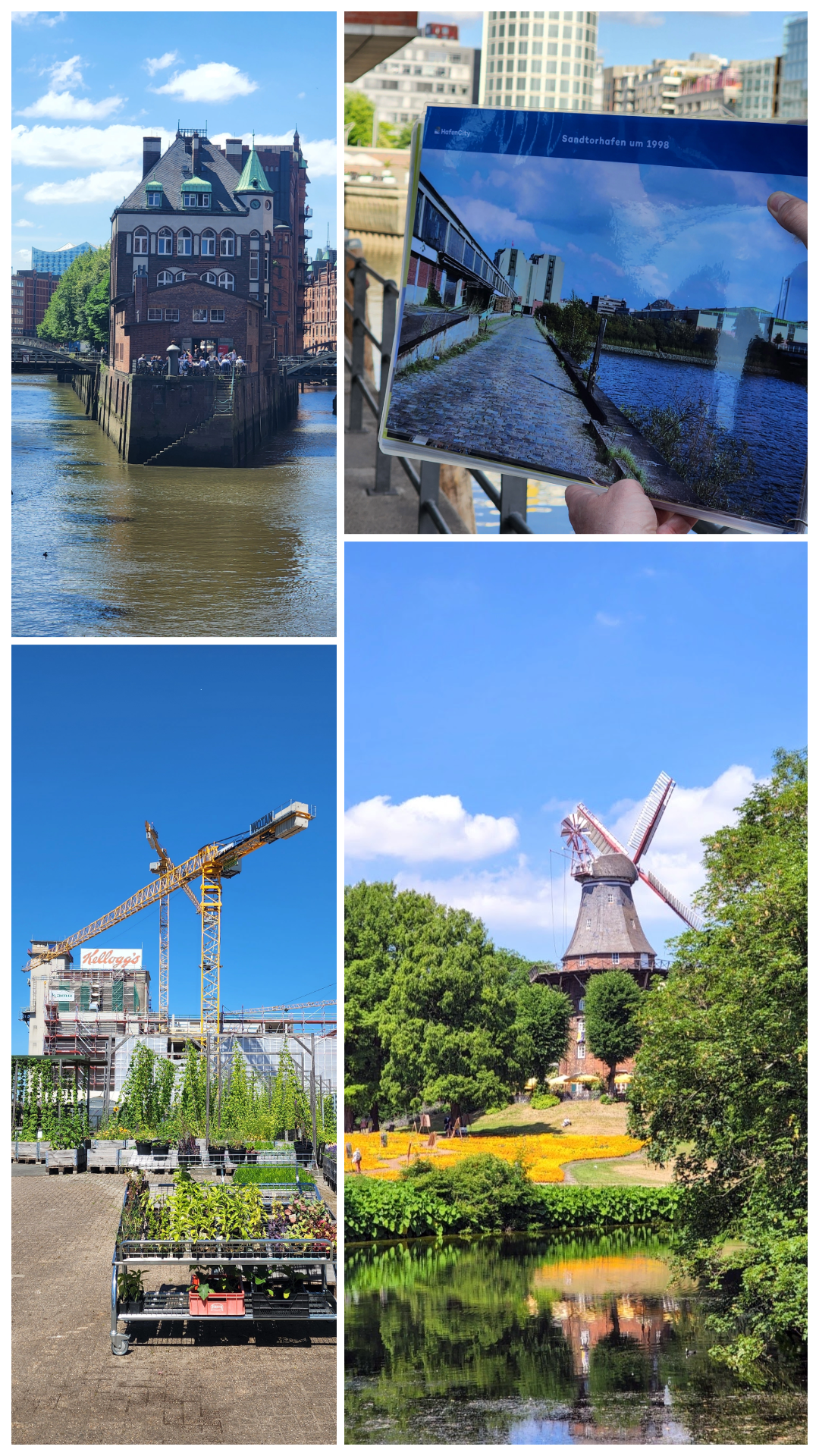
A few years ago, I had the incredible opportunity to travel to Hamburg and Bremen (Germany) with the German American Chamber of Commerce. We were there to see firsthand how Germany is tackling large-scale, eco-friendly, and adaptable mega-projects. From HafenCity in Hamburg to the repurposed industrial zones in Bremen, the technical innovation was staggering. But it left me with a nagging question that all of us planning nerds eventually ask: these projects are resilient, but are they fair?
A fascinating new paper in the journal Cities dives headfirst into this question, exploring how cities can weave social equity into the fabric of their climate adaptation plans. The authors, Hannah Berner, Sonia De Gregorio Hurtado, and Enrico Gualini, introduce a powerful concept called “equitable resilience” and use it to compare the different paths taken by two of Europe’s most progressive cities: Barcelona and Berlin. The results are a must-read for anyone thinking about the future of our cities.
It’s Not Just About Bouncing Back, It’s About Bouncing Forward—Fairly
For years, “resilience” has been the buzzword in planning, often defined as a city’s ability to withstand shocks like heatwaves or floods and bounce back. But the authors argue this isn’t enough. Climate change doesn’t affect everyone equally; it hits marginalized communities the hardest. True resilience, they argue, means tackling these underlying inequities head-on.
They frame “equitable resilience” around three core dimensions of justice:
- Recognitional Justice (Seeing the Invisible): This is about formally acknowledging that different groups face different risks. Planners must recognize that vulnerability isn’t just about living in a flood plain; it’s shaped by factors like age, income, gender, and health.
- Procedural Justice (A Seat at the Table): This demands that decision-making is inclusive and transparent. It’s not enough to hold a town hall; cities must actively reach out to and incorporate the knowledge and experiences of vulnerable and often-excluded communities.
- Distributional Justice (Sharing the Good Stuff): This is the classic “who gets what” question. It means ensuring that the benefits of climate adaptation—like new parks, cooling centers, and green infrastructure—are distributed fairly, prioritizing the communities that need them most.
The Case Studies: Barcelona’s People-Powered Justice vs. Berlin’s Data-Driven Precision
The paper puts this framework to the test by analyzing the climate plans of Barcelona and Berlin, two cities celebrated for their progressive planning but with surprisingly different philosophies.
Barcelona: The Community Champion
Barcelona’s approach is rooted in a powerful, explicitly stated mission: achieving “climate justice”. This isn’t just jargon; it’s a guiding principle that shapes their entire strategy.
- Process: The city’s plans were born from a network of citizen organizations and social movements. They use a
- co-productive process, employing workshops and the digital platform Decidim (‘We Decide’) to involve the public directly in creating solutions.
- Recognition: Their strategy goes deep, creating a heat-wave vulnerability index that cross-references temperature with socio-economic factors like age, health, and housing quality to identify the neighborhoods most at risk.
- Distribution: Barcelona’s plans feature both specific and generic measures. They plan for
climate shelters and green infrastructure in prioritized areas. But more radically, they also implement broad social policies, like a “no cuts” rule preventing utilities from shutting off power or water for vulnerable households and creating “care superblocks” to deploy social and care workers to strengthen local support networks.
Berlin: The Technical Virtuoso
Berlin, in contrast, takes a more conventional, expert-driven approach. The city’s strategies are technically impressive but lack the strong, unifying moral framework seen in Barcelona.
- Process: Berlin’s planning process was led by sectoral agencies and a research institute, with participation largely limited to a professional community of stakeholders. The public and vulnerable groups were not directly consulted in the development of the core strategies.
- Recognition: Berlin has a powerful tool: the Environmental Justice Atlas. This incredible map overlays environmental burdens (like air pollution and noise) with social vulnerability data, creating a comprehensive city-wide picture of inequity. However, the paper finds that this intersectional analysis is often disconnected from the main adaptation strategy, which focuses more on a technical “sectoral vulnerability” (e.g., how is the water infrastructure affected?).
- Distribution: Here lies the biggest gap. While the plans acknowledge that disadvantaged districts need special attention, the detailed vulnerability analyses from the Atlas have not yet been translated into concrete, targeted planning measures. There’s a disconnect between their excellent data and their on-the-ground actions.
What Can We Nerds Learn From This?
This comparison isn’t about crowning a winner. Instead, it offers crucial lessons for planners everywhere who are serious about building equitable cities.
- Data Isn’t Enough: Berlin’s case is a powerful reminder that even the most sophisticated maps and data sets are of limited use without a clear political commitment and a procedural framework to act on them.
- Process Is Power: Barcelona shows that rooting a climate plan in community co-production and social movements builds the legitimacy and local knowledge needed for transformative change.
- Think Beyond Green Roofs: True climate resilience is as much about social policy as it is about physical infrastructure. Barcelona’s focus on preventing energy poverty and providing social care is a game-changing example of “generic” adaptation measures that build a community’s underlying capacity to withstand shocks.
- Words Matter: By putting “climate justice” at the center of its strategy, Barcelona created a north star for all its actions. Berlin’s lack of a similar normative core led to a more fragmented and less transformative approach.
As I reflect on the incredible engineering I saw in Hamburg and Bremen, this paper adds a crucial dimension to the conversation. Building resilient cities isn’t just a technical challenge; it’s a moral one. The question we must constantly ask ourselves is not just can we adapt, but for whom are we adapting?
https://www.sciencedirect.com/science/article/pii/S0264275125001362





 Planningnerd.net